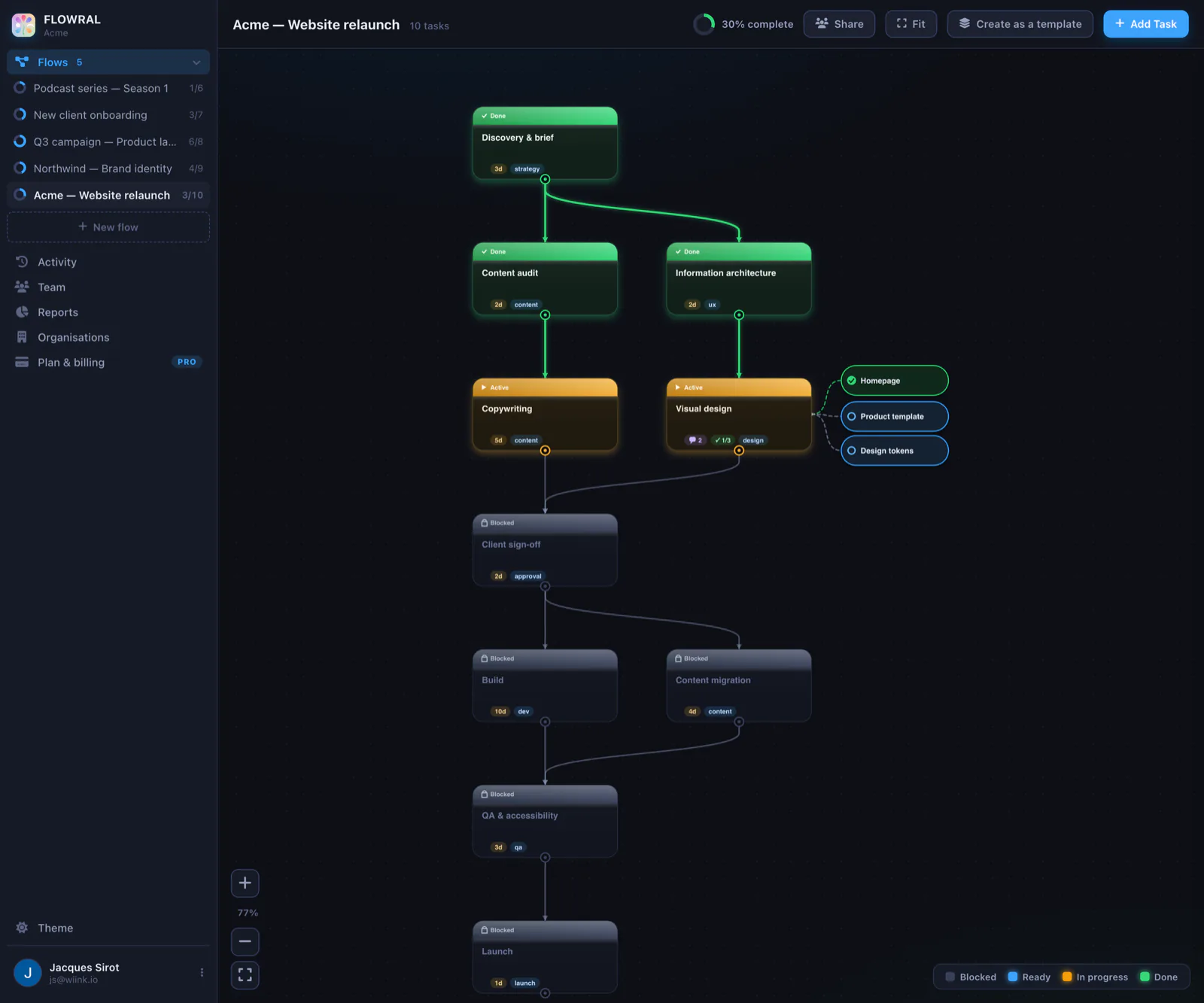
Engineering has tools. Client delivery doesn't. Between the estimate and the handover sit a dozen dependencies that no issue tracker enforces: the API contract, the design freeze, the review, the QA pass, the client's approval. Flowral makes those the plan — and stops work that isn't ready from appearing at all.
✦ Free forever for two people · Clients never cost a seat · Runs alongside your issue tracker
Nobody estimates the four days a pull request sits unreviewed, or the week the client took to look at staging. Those are where fixed-price projects go underwater.
The front end gets built against an API shape that changes the following week. It wasn't a misunderstanding — the build task was simply available before its prerequisite was done.
"Don't deploy without a second pair of eyes" holds right up until a Friday. A gate that lives in a team agreement is a gate that is negotiable under deadline pressure.
Your tracker has your work in it. It doesn't have "client provides copy" or "legal approves terms" — so those slip silently, and the delay lands on your timeline.
Docs, credentials, a walkthrough, a support window. Every studio has a checklist. Very few have it as work that blocks calling the project finished.
Model the build once. Each task states what has to be true before it exists, and Flowral holds the line.
Not everything needs every approval. A gate can demand two of three reviewers, or a specific pair — engineering lead and the client — before the work downstream becomes available to anybody.
Jira and Linear are built for an engineering backlog: issues, triage, sprints, releases, velocity. They are good at that and Flowral is not trying to be. If what you need is issue tracking, keep what you have — you don't need us.
What those tools don't model is the delivery wrapper: the client's approvals, the design freeze, UAT, the handover, and the fact that half the prerequisites belong to people who will never open your tracker. That work is usually managed in a spreadsheet, a recurring call, and somebody's memory — which is exactly where fixed-price projects lose their margin.
Most studios that use Flowral run both. Engineering stays where it is. The client-facing shape of the project — what's blocked, what's waiting on whom, what "done" requires — lives in a flow that the client can actually see. Two tools, two jobs, no overlap worth arguing about.
Free for two people, forever. Clients and guests are free on every plan, so the people who block you cost nothing to include.
Start free, no card neededUsually not, and we would rather say so. Jira and Linear are built for an engineering backlog — issues, sprints, triage, releases. Flowral is built for the delivery wrapper around that: the client's brief, the approvals, the QA gate, the handover. Studios that run both keep engineering in Linear and run the client-facing delivery in Flowral. If your problem is issue tracking, Flowral is the wrong tool.
Flowral does not model sprints, and it does not try to. A flow is the shape of the deliverable, not the shape of your cadence. Teams typically map the build once and pull ready work into whatever iteration they run. If your process depends on sprint ceremonies being represented in the tool, this is not that tool.
Yes — that is what gates are for. A task can require all of its prerequisites, or X of N: "ship to prod" can need two of three reviewers plus the client sign-off. The rule is enforced, so the deploy task is not available to anyone until the count is met.
Yes. Clients and guests are free on every plan and see only the flows you share with them. They get progress and the activity feed on that work — not your internal estimates on everything else, and not a seat on your bill.
Not today. There is no GitHub, GitLab or CI integration, and we would rather you knew that before signing up than after. Completion is marked by people, not by a merge. If automatic status from your pipeline is a requirement, Flowral does not meet it yet.
Also built for creative & marketing agencies and consultancies.